
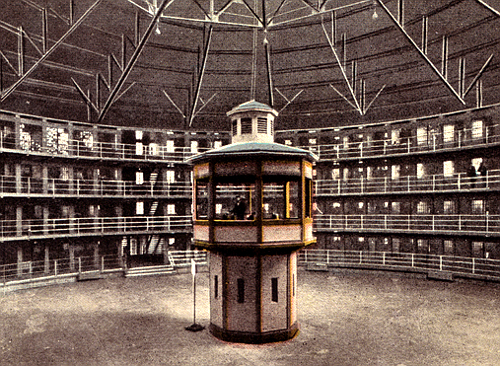
Many thinkers and writers believe the CCTV (Closed Circuit Television) system was inspired by the panopticon model produced by Jeremy Bentham, an English philosopher and one of the key theorists of classicism, who believes the aim of punishment is to maximise pain and minimise pleasure. The panopticon was originally built and designed in the 19th century where prison officers have the authority to scrutinize prisoners’ actions and behaviour but, the prisoners cannot watch each other or the prison officer by restricting opportunities for criminality as a response to his pain – pleasure philosophy. Lyon (2006 cited in Matthews (2009: 250) suggests that the increase use of CCTV and other monitoring techniques such as electronic tagging represents a broad system of endless surveillance, which operates round the clock.
However, Zygurt Bauman (1998 cited in Matthews 2009: 250) criticised his (Jeremy Bentham) panopticon as it does not apply to all societies particularly in the private sphere. Many controversial debates asks whether the UK is becoming a “Big Brother” surveillance model, where we are monitored on what we do in the public sphere and we are now actors in our own movies produced by CCTV. Some could argue that surveillance could affect our mental well – being as the audience would be given the impression that CCTV will create a “schizophrenic” society due to exacerbated feelings of paranoia. Norris and Armstrong (1998 cited in Ditton 2000: 692) notes that open – street CCTV in the UK was an investment made by the central and local governments between 1994 and 1997. Prior to this investment, it had been believed by various research conducted, revealed that CCTV had a big impact on closed locations, such as buses, London Underground Services, car parks, buses and shops ( Van Straelen 1978; Burrows 1991, Gill and Turbin 1997, Poyner 1988;1991 Tiley 1993, Mayhew et al 1979 and Hearnden 1996 cited in Ditton 2000: 692).
The intention of CCTV is to monitor our behaviour and actions in public places, creating a safer society. The images can be recorded and stored as sources for evidence for crime and anti – social behaviour. Videos from CCTV are then watched by the police, other members of the law enforcement, members of the criminal justice system and people within policing, such as staff and security guards at airports, cinemas, theatres and shops. It is suggested that CCTV aids law regulation and acts as an anti – criminal aid. Peter Fry, director of the CCTV user group quoted that: “Officers will be looking at every single camera in the area and trying to get hold of as many tapes as they can”. He also added that CCTV produced more than 10,000 tapes in the 7/7 bombings (The Independent 29th June 2007).
From the Hawkeye case study, commissioned by the Home Office which researched on numbers of motor – vehicle theft in London Underground station car parks. The Hawkeye system consisted of having 646 fixed static cameras across 60 car parks with the provision of almost 100 per cent coverage of marked parking spaces with many objectives including the reduction on the rates of vehicle related crimes in car parks by 55 per cent by March 2003. The system intended to deter potential offenders, increase detection of offences by providing evidence, which could lead to successful prosecutions and increase detection of offences through the uses of surveillance and instant deployment police to the scene of the offence (Gill, Little, Spriggs, Allen, Argomaniz and Waples 2005:1). The 3 control rooms had operators paid by the British Transport Police to record incidents within the car parks
The Hawkeye case study concluded that crime rates among vehicle – related theft has been decreased by 73 per cent and this was achieved by March 2003. However, the Hawkeye system was ineffective because of poor management skills among the operators and loss of evidence due to short maintenance time of tapes. The operators were unable to spot incidences because they could only see through 6 per cent of their cameras and could only monitor 16 hours a day. There was also a barrier in communication between the detection of incidence and the main British Transport Police control room. Another piece of research about CCTV was conducted in Glasgow, which contained public attitudes and opinions towards CCTV.
It has been revealed that the respondents who took part in the research showed strong support towards the facility of CCTV compared to the respondents who were interviewed by a local newspaper in King’s Lynn by 96 per cent and residents of Harlow by 90 per cent who were interviewed by P French in 1996. (Geake 1993 cited in Ditton 2000: 693). French also interviewed people with criminal convictions and learnt that 65 per cent of juveniles also approve of CCTV as well as 75 per cent of adults with criminal convictions. Researchers in Glasgow asked the respondents about their safety when visiting the city centre, asked if they try to avoid certain areas and about their fears of being victims of crime. The results revealed that 2 per cent of the respondents were anxious of walking home alone, as it is suggested that the respondents who were interviewed on that particular subject were female. Hence, females outnumbered males by a ratio of 2:1.
Males are believed to have no fear of being victimised when walking home alone, as they are considered to be subconsciously influenced by stereotypical masculine characteristics. Radical feminists may argue that women fear of being victims of physical or sexual assaults by male strangers as they feel it illustrates patriarchal dominance, despite the majority of perpetrators are close acquaintances. Later results revealed that 50 per cent of the respondents which can include both men and women were fearful of being victimized. Other results revealed that anxieties about crime increased significantly with those who were interviewed especially after dark (Ditton 2000: 698). As a result, respondents change their walking routes and avoid certain areas which may put them at risk of victimisation. It can be considered that attitudes and stereotypes among gender can play an influence on how respondents react towards questions about their personal safety and fear of crime. On regards of whether the residents in Glasgow feel safe around CCTV, 42 per cent of public felt CCTV did not make any differences and 56 per cent say they feel safer and 81 per cent overall feel safe already when walking home alone (Ditton 2000: 702).
His journal (Jason Ditton) on public attitudes towards CCTV in areas of Glasgow was researched by using surveys and close – ended questionnaires in three different areas of Glasgow, where CCTV cameras installed in the city centre and two busy areas of Glasgow which do not have CCTV, but have other methods of control such as street lighting. Those venues were based for research in every late January for 3 years. Surveys were conducted on different fixed hours between 8am and at midnight. The selected locations had similar characteristics, such as containing crossroads, sides bordered with shops and each town has a nearby nightclub (Ditton 2000: 695), which can suggested to contribute on a number of people, particularly youngsters being asked about safety when it comes to walking home alone.
The uses of technology have been taken advantage of for numerous years to tackle crime. There are various positive sides of the uses of CCTV, include the improvement of crime reduction and prevention which was seen as a way for public protection. It was also used as a vital piece evidence on violent crimes among people and other minor and victimless crimes in the streets and even on public transport which are usually illustrated within the prosecution services. The principle of deterrence of potential offenders can be highlighted as the main objective for the purpose on the development of CCTV. It can be argued that CCTV is in favour of preventing the miscarriages of justice among the innocent. However, CCTV may be criticised as not being effective as DNA profiling.
Although CCTV can be beneficial for crime prevention, deterrence and improvements on the relationships with the police and protection of the general public, there are negative sides of it. The House of Lords Report on Surveillance Society where Alan Travis, a home affairs editor argues that CCTV can violate peoples’ personal space. Former Tory chief Lord Goddard argued that the high rises of surveillance and data collection by the state and other organisations challenges long –standing traditions of privacy and individual freedom which are vital for democracy. CCTVs could send plagues of moral panic among the general population binded bt media exaggeration. Nic Goombridge wrote an article explaining that the government wastes a lot of tax payers’ money towards funding CCTVs. His article mentioned that the Hawkeye system was the most expensive investment made by the home office (Goombridge 2008: 76). This concurs with argument that taxpayers’ expenses should be invested towards crime awareness education particularly, young people who should be educated on the dangers of knife crime and other criminal activities.
UK is now turning into a pan-optic surveillance society which continues to increase because of our dependency on technology. This would be beneficial for safety and security in urban living as residents will feel confident about feeling safe and protected in public spheres and ameliorate the use of space and time. It also increased high prosecution levels, convicting the guilty and strictly monitor highly dangerous and violent offenders through electronic tagging. It also acts as a deterrent towards potential offenders and those who are likely to re – offend. However, it was criticised that the pan-optic surveillance society may cause bias among social classes as members of the lower classes may feel more targeted than their upper classes counterparts and will be more anxious that CCTVs will hamper their private space subjecting them to future humiliation by close members of the public which are known to them as aquintances like friends and family members.
Bauman, Z (1998) Globalization: The Human Consequence, Cambridge Polity Press
Burrows, J (1991), Making Crime Prevention Pay: Initiatives from Business, Crime Prevention Unit Paper 27. London Home Office.
Ditton, J (2000) Crime and the City: Public Attitudes towards Open Street CCTV in Glasgow British Journal of Criminology vol40 pp692 – 709
French, P (1996) ‘Inside the Offenders Mind’, CCTV Today 3/3:16 – 19
Geake, E (1993), ‘The Electronic Arm of the Law, New Scientist, 8 May
Gill, M, Little, R, Spriggs, A, Allen, J, Argomaniz, J and Waples, S (2005) Assessing the impact of CCTV: The Hawkeye Case Study, Home Office Online Report 12/05, London: Home Office.
Gill, M and Turbin, V (1997), ‘CCTV and Shop Theft: Towards a Realistic Evaluation’, paper presented to the British Journal of Criminology, Conference, Belfast, July.
Goombridge, N (2008) Stars of CCTV? How the Home Office wasted millions – a radical ‘Treasury/Audit Commission view, Surveillance & Society 5 (1): 73 – 80.
Hearnden, K (1996) ‘Small Business’ Approach to Managing CCTV to Combat Crime’, International Journal of Risk, Security and Crime Prevention 1/1: 19 – 31.
Kirby, J (2007) CCTV footage scoured in hunt for clues, The Independent, June 29 www.independent.co.uk/news/crime/cctv-footage-scoured-in-hunt-for-clues(Accessed 7th April 2010)
Lyon, J (2006) ‘The Foreigners Still Locked in Our Jails and Other Scandals’, Guardian, 27 April
Matthews, R (2009) Doing Time: An Introduction to the Sociology of Imprisonment, Hampshire, Palgrave
Mayhew, P, Clarke, R, Burrows, J, Hough, J and Winchester, S (1979), Crime in Public View, Home Office Research Study 49. London: Home Office.
Poyner, B (1988) ‘Video Cameras and Bus Vandalism’, in R.V. Clarke, ed Situational Crime Prevention Successful Case Studies, 174 – 84, New York: Harrow and Heston.
Tilley, N (1993) Understanding Car Parks, Crime and CCTV: Evaluation Lessons from Safer Cities, Crime Prevention Unit Paper 42. London: Home Office.
Travis, A (2009) Lords: Rise of CCTV is threat to freedom, The Guardian, February 6: House of Lords Report on Surveillance Society: http://www.publications.parliament.uk/pa/Id200809/Idselect/Idconst/18/1802.htm.
Van Straelen, F (1978) ‘Prevention and Technology’, J. Brown ed., Cranfield Papers. London: Peel Press.

 Phil the Writer's Block