Tag Archives: CCTV

Why has risk minimization come to dominate the criminological agenda and how does it implicate with crime control policies?

Risk minimization was considered to be a stepping stone to dominate the criminological agenda as the criminal justice system now is drifting from post – crime to the pre – crime era. There had been changes in the areas of criminal justice particularly, rehabilitation. as it provided an inspiration for development in self-control strategies against offending and ameliorated the levels for public security and safety. Rehabilitation now concentrates more on strategies to protect the public by hampering spaces that encourages crime and criminal activities, imposing restrictions on offenders’ whereabouts than concentrating on their welfare and needs, such as the provision of guidance and psychological support (Straw 1998 cited in Garland 2001: 176).

Garland (2001: 186) argued that prior to the 1970s, there were no programmes of policing, no substantive interests in crime events and no theory of social and economic routines that generated criminal opportunities and criminogenic situations. Jock Young  who could agree with Durkheim, highlights that crime is seen as a social fact and is part of everyday life and highlighted that Garland outlined the rises of discipline during late modernity such as penal – segregation and preventative partnership which appears to be obvious when the states makes a gesture of law and order persuading the public into believing the state has control over crime (Jock Young 2003: 230). Tim Owen who reviewed David Garland’s book, The Culture of Crime Control, illustrated there are powerful arguments about the rise of  the “schizophrenic” crime control complex and emphasised the decades of crime policies following the Second World War, which was known as the ‘Golden Age’ of penal – welfarism. This period consisted of two important ideas of crime control. The first concentrates on social cohesion that could reduce the rates of crime and the second feels that the state should take accountability for the offenders’ welfare (Owen 2007: 3).

Information Technology played a vital part on crime control and risk management, particularly the uses of CCTV and offender databases. Michel Focault, a French Philosopher who is renowned to criminologists for his book Discipline and Punish published in 1975. The Foucauldian body included works on asylum, the hospital and the regulations of sexuality and punishment (Valier 2003: 149). She (Valier) also highlighted that his (Foucault) work rejected the narratives of the humanitarian development, as it was seen as the negative side of the Enlightenment. Foucault highlighed the notion of genealogy, a study of families and its history. For him, genealogy is about the criminology of us, where history is used to help us understand ourselves and others and what issue was taken for granted and investigates whether there is a historical cause of re- offending (Poster 1984 cited in Valier 2003: 151). It agrees with Garland who suggests that staff in the criminal justice system uses their personal strategies of self-control, which can be applied onto dealing with offenders, such as counselling and alternative interventions such as anger management and therapies involve creative arts (Garland 2001:189).

Valier moves onto discuss that Foucault’s work highlights the link of knowledge and power and cannot be separated as he states:

“There is no knowledge without the exercise of power and there is no power without knowledge” (2003: 152).

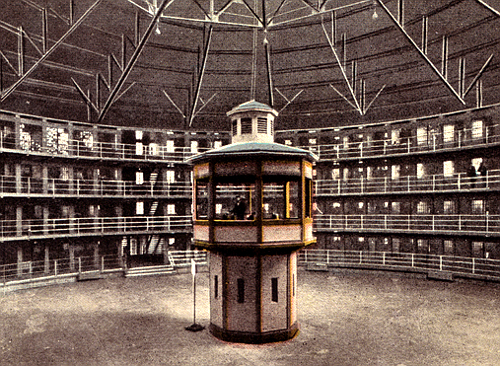
His book Disicipline and Punish, experiments with the two concepts and used the example on the changes in the mode of punishment. The era of the French Revolution had one basic form of punishment which circled around a public display of corporal and capital punishment, which illustrates the exploitation of knowledge and power (Valier 2003: 153). The panoptical society is argued to play an influence on risk minimization. This notion was inspired by Jeremy Bentham who is renowned for his philosophy of pain – pleasure. The panopticon was applied in prisons where inmates were monitored for their behaviour and actions during incarceration. Although Foucault was not apprehended with Bentham’s supposed intentions, he was more alarmed with the political technology considered by the Panopticon (Valier 2003: 158). He also believes the panoptical option is considered to be strict by providing a severe form social regulation and control. Foucault’s analysis of the panopticon may contribute to CCTV and computerised databases. George Orwell’s Novel Nineteen Eighty – Four  strongly seized the imagination of the post-war vital awareness with its vision of a total surveillance society and this was also predicted in James’s Rule book Private Lives and Public Surveillance which he provided the benefits of total surveillance:

“The system would work to enforce observance with a uniform set of norms governing every aspect of everyone’s behaviour. Every action of every client would be analysed, recorded, evaluated both at the moment of occurrence and forever afterwards. The system would bring the whole fund of its information to bear on every decision it made about everyone. Any sign of disobedience – present or anticipated – would result in corrective action” (Rule 1973: 37 cited in Valier 2003: 161).

Foucault’s notion of disciplinary power was  considered to be the outcome of numerous arguments about an inspecting glaze in the panoptical society across a range of texts that argues that we are now shifting into a post – disciplinary period of control where power does not reside in a foreign gaze (Valier 2003: 163). Valier stated that Foucault was criticised for concentrating on how work is applied on self experiences rather than using technology to degrade criminals such as, the name and shaming” technique (Valier 2003: 163). She (Valier) also mentioned that the governments’ view of power is only applied on an active subject, such as the relationship between the bourgeoisie and the proletarians and reactions and public attitudes towards monitoring (Valier 2003: 163). Tim Owen had highlighted problems regarding Garland’s Foucauldian analysis in particular his (Garland) dependency on Foucault’s  knowledge and power link. Best and Kellner (1991 cited in Owen 2007: 8) argues that Garland’s book needs to consider some social agents which seize and hold more power than others.

Power (1994 cited in Garland 2001: 190) argues that criminal justice agencies have been drawn into an audit society and information to the public management are shared among each body. He (Power)  illustrates that the neo-liberal programmes often achieve control by relying on audits (1996, 1997; 2003a cited in Levi 2008: 585). He (Power) also argued that as soon as they are limited to financial institutions, audits have been expanded to a wide number of fields, including universities, hospitals and government agencies (Power 1996 cited in Levi 2008: 585). The study of audit was argued to attract widespread attention in scholarships on institutions and are mostly research at present, but has not linked this attention to communities in criminal justice (Levi 2008: 585). However, criminological research conducted by Adam Crawford who demonstrates that the turn to new managerial into auditability has promoted this very turn to community in which short-term programmes can be readily more evaluated (Crawford 1999a cited in Levi 2008: 585). Kevin Stenson (2005; Stenson and Edwards 2003 cited in Levi 2008: 585) argued that this audibility could reproduce class – based inequalities in local contexts.

The Florida Department of Corrections display an example of an audit society by distributing  personal details that are released into society which in contrast, the thoughts of policies that deal with rehabilitation of offenders made it illegal to disclose any  information about ex offenders’ whereabouts (LHO 1997 cited in Garland 2001: 180). Megan’s Law is another example, named after Megan Kanka, a seven-year old girl who was raped and murdered by her neighbour Jesse Timmendequas, a convicted sex offender in Hamilton Township, New Jersey. The murder and criminal history of Mr Timmendequas sparked outrage and consequently, Megan’s Law was launched, where parents and members of the community to obtain access for information of any child molester living in their neighbourhoods. Megan’s Law had categorised sex offenders determined by their chances of re-offending if they integrate into society. Stage One contains those who are at low risk  and prosecutors alert this stage to law enforcement agencies. Stage Two are those who presumed to be at moderate risk  and prosecutors will notify eligible community organizations, such as youth clubs, day care centres and schools etc. Stage Three are those who are at high risk and be subjected to full – blown community notification (Levi 2008: 588). Levi also noted that over 11,000 registrants were added monthly with the New Jersey State Police, with approximately 60 per cent have been placed in Stages Two and Three.

However, Megan’s Law also have been applied on law – abiding citizens, particularly the rules of conduct where in order for members of community to receive information of sex offenders living in their neighbourhood, they are obliged to sign a contract pledging not to violate the codes of conduct by disclosing any information to any members outside the community and information should be shared appropriately (Shapiro 1987 cited in Levi 2008: 593). In the case of notifications to local schools when school principals are notified, a state liaison provides them a ‘School Personnel Rules of Conduct’ and ‘Information Reference Sheet for School Principals’ and reassessed on how notice should be stored and limits on its communication among staff members. Once principals sign the School Principal Receipt Form, they are obliged to follow the rules within the code of conduct and forms are kept by the prosecutor’s office. Levi highlighted that Megan’s Law was criticised for lacking in penalties against those who selfishly disclose any information of sex offenders to members who are outside the community or class organisations (Paul P. V Farmer 2000; 227 F. 3d 98 cited in Levi 2008: 597).

The sex offender’s register acts as a deterrent by stigmatizing convicted sex offenders and serves as a warning tool to those who contemplate of offending and symbolizes retribution. This seems to concur with Dave Garland who applies the criminology of the self on offenders where they are seen as monstrous psychopaths who shed no remorse or empathy (Garland 2001: 184). John Major  argues that the criminology of self encourages the public to be alert and prepare to defend themselves against these “monsters”(1993 cited in Garland 2001: 184). Even though the sex offender’s register acts as a powerful deterrent, it can  damage the offender’s self –esteem and in consequence, encourages re-offending in away to reinstate in incarceration. Megan’s Law considers to symbolize state power and the division of labour between the state and the community,which predicts that communities are at risk of being plagued with fear and doubts about safety (Ericson 2007a; Simon 2000 cited in Levi 2008: 599).

Risk minimization is considered to revolve around community and therapeutic interventions, such as anger management and drug counselling. Pat O’ Malley drew attention to drug harm minimization which were developed as a form of resistance, created by the governments in New Zealand and Australia in defence against the War on Drugs campaign  in the USA (O’Malley 2008: 457). These policies assume that drug addiction considered to be a possible threat to themselves and public safety by the possibility of contracting HIV through shared needles and exposure to vulnerable people in vulnerable “hot spots”. It does not only apply to illegal drugs but on tobacco, alcohol and prescribed drugs (O’Malley 2008: 458). He (O’Malley) also recommends that drug users should take responsibility for minimising their risk of drug harm by attending drug rehabilitation centres, receive advice practicing safe drug administration and usage and take advantage accessing methadone to help them reduce their drug cravings (2008: 458). Dave Garland (1996 cited in O’Malley 2008: 459) can agree with classicist thinkers by arguing that drug users are chose to be drug addicts or drug than their social, psychological and environmental influences.

Risk minimization appears to be optimistic and realistic in dealing with crime, especially changes in rehabilitation as it concentrates on public safety and hampering spaces in areas which breeds criminality than attempt to make offenders into law-abiding citizens. However, the uses of CCTV and distribution of databases particularly and sex offenders register seem to deliver plagues of moral panic and paranoia in the public sphere, which could result in vigilantism. Foucault should be praised for his analysis on the panopticon and contribution on risk minimization by applying the link of  knowledge and power. The implications of crime control policies aim to protect the public, enhance public security and ensure communities are involved and take responsibility for their personal safety and safety of public spaces.

Best, S and Kellner, D (1981) Postmodern Theory: Critical Interrogations. London: Macmillan

Crawford, A (1999a) The Local Governance of Crime: Appeals to Community and Partnerships, New York: Oxford University Press.

Ericson,R (2007a) Crime in an Insecure World. Cambridge, Polity

Garland, D (1996) ‘The Limits of the Sovereign State’, British Journal of Criminology 36: 445 – 71

(2008) The Culture of Control: Crime and Social Order in Contemporary Society, Oxford, Oxford University Press.

Levi, R (2008) Auditable Community: The Moral Order of Megan’s Law, British Journal of Criminology vol 48 pp 583 – 603

Major, J (Prime Minister) The Sunday Times,  21 February 1993

Home Office, The Rehabilitation of Offenders Act 1974 : A Consultation Paper  (London Home Office 1999)

O’Malley, P (2008) Experiments in risk and criminal justice, Theoretical Criminology, 12/4 : pp451 – 469

[1]Orwell,G (1949/1990) Nineteen Eighty – Four. London Penguin

Owen, T (2007) Culture of Control: Through a Post – Foucauldian Lens, Internet Journal of Criminology

[1]Poster, M (1984) Foucault, Marxism and History: Mode of Production Versus Mode of Information. Cambridge Polity.

Power, M, (1994) The Audit Explosion, London, Demos

-(1996) , Making Things Auditable’, Accounting, Organizations and Society, 21: 289 – 315

-(1997), The Audit Society: Rituals of Verification. New York: Oxford University Press

-(2003a) ‘Evaluating the Audit Explosion’, Law and Policy, 25: 185 – 202

Simon, J (2000), ‘Megan’s Law: Crime and Democracy in Late Modern America’, Law and Social Inquiry, 25: 1111 – 50

Shapiro, S (1987), ‘The Social Control of Impersonal Trust’, American Journal of Sociology, 93: 623 – 58

Straw, J (1998) ‘Crime and Old Labour’s Punishment’, The Times 8 April 1998

Stenson, K and Edwards, A (2003), ‘ Crime Control and Local Governance: The Struggle for Sovereignty in Advanced Liberal Polities’, Contemporary Politics, 9: 203 – 18

Stenson, K (2005) ‘Sovereign, Biopolitics and Community Safety in Britain’, Theoretical Criminology, 9: 265 – 87.

Rules, J.B (1973) Private Lives and Public Surveillance: Social Control in Computer Age. New York: Schochen Books.

Valier, C (2003) Theories of Crime and Punishment, Harlow, Longman Press, Ch8

Young, J (2003) Searching for a New Criminology of Everday Life: A Review of ‘The Culture of Control’, by David Garland (New York: Oxford University Press 2001), British Journal of Criminology, 43,1 pp228 – 243.
Leave a comment

Filed under Academic Writings

Has the UK turned into a panoptic society that benefits urban safety and security?

panopticon

Many thinkers and writers believe the CCTV (Closed Circuit Television) system was inspired by the panopticon model produced by Jeremy Bentham, an English philosopher and one of the key theorists of classicism, who believes the aim of punishment is to maximise pain and minimise pleasure. The panopticon was originally built and designed in the 19th century where prison officers have the authority to scrutinize prisoners’ actions and behaviour but, the prisoners cannot watch each other or the prison officer by restricting opportunities for criminality as a response to his pain – pleasure philosophy. Lyon (2006 cited in Matthews (2009: 250) suggests that the increase use of CCTV and other monitoring techniques such as electronic tagging represents a broad system of endless surveillance, which operates round the clock.

However,  Zygurt Bauman (1998 cited in Matthews 2009: 250) criticised his (Jeremy Bentham)  panopticon as it does not apply to all societies particularly in the private sphere. Many controversial debates asks whether the UK is becoming a “Big Brother” surveillance model, where we are monitored on what we do in the public sphere and we are now actors in our own movies produced by CCTV. Some could argue that surveillance could affect our mental well – being as the audience would be given the impression that CCTV will create a “schizophrenic” society due to exacerbated feelings of paranoia. Norris and Armstrong (1998 cited in Ditton 2000: 692) notes that open – street CCTV in the UK was an investment made by the central and local governments between 1994 and 1997. Prior to this investment, it had been believed by various research conducted, revealed that CCTV had a big impact on closed locations, such as buses, London Underground Services, car parks, buses and shops ( Van Straelen 1978; Burrows 1991, Gill and Turbin 1997, Poyner 1988;1991 Tiley 1993, Mayhew et al 1979 and Hearnden 1996 cited in Ditton 2000: 692).

The intention of CCTV is to monitor our behaviour and actions in public places, creating a safer society. The images can be recorded and stored as sources for evidence for crime and anti – social behaviour. Videos from CCTV are then watched by the police, other members of the law enforcement, members of the criminal justice system and people within policing, such as staff and security guards at airports, cinemas, theatres and shops. It is suggested that CCTV aids law regulation and acts as an anti – criminal aid. Peter Fry, director of the CCTV user group quoted that: “Officers will be looking at every single camera in the area and trying to get hold of as many tapes as they can”. He also added that CCTV produced more than 10,000 tapes in the 7/7 bombings (The Independent 29th June 2007).

From the Hawkeye case study, commissioned by the Home Office which researched on numbers of motor – vehicle theft in London Underground station car parks. The Hawkeye system consisted of having 646 fixed static cameras across 60 car parks with the provision of almost 100 per cent coverage of marked parking spaces with many objectives including the reduction on the rates of vehicle related crimes in car parks by 55 per cent by March 2003. The system intended to deter potential offenders, increase detection of offences by providing evidence, which could lead to successful prosecutions and increase detection of offences through the uses of surveillance and instant deployment police to the scene of the offence (Gill, Little, Spriggs, Allen, Argomaniz and Waples 2005:1). The 3 control rooms had operators paid by the British Transport Police to record incidents within the car parks

The Hawkeye case study concluded that crime rates among vehicle – related theft has been decreased by 73 per cent and this was achieved by March 2003. However, the Hawkeye system was ineffective because of poor management skills among the operators and loss of evidence due to short maintenance time of tapes. The operators were unable to spot incidences because they could only see through 6 per cent of their cameras and could only monitor 16 hours a day. There was also a barrier in communication between the detection of incidence and the main British Transport Police control room. Another piece of research about CCTV was conducted in Glasgow, which contained public attitudes and opinions towards CCTV.

It has been revealed that the respondents who took part in the research showed strong support towards the facility of CCTV compared to the respondents who were interviewed by a local newspaper in King’s Lynn by 96 per cent and residents of Harlow by 90 per cent who were interviewed by P French in 1996. (Geake 1993 cited in Ditton 2000: 693). French also interviewed people with criminal convictions and learnt that 65 per cent of juveniles also approve of CCTV as well as 75 per cent of adults with criminal convictions. Researchers in Glasgow asked the respondents about their safety when visiting the city centre, asked if they try to avoid certain areas and about their fears of being victims of crime. The results revealed that 2 per cent of the respondents were anxious of walking home alone, as it is suggested that the respondents who were interviewed on that particular subject were female. Hence, females outnumbered males by a ratio of 2:1.

Males are believed to have no fear of being victimised when walking home alone, as they are considered to be subconsciously influenced by stereotypical masculine characteristics. Radical feminists may argue that women fear of being victims of  physical or sexual assaults by male strangers as they feel it illustrates patriarchal dominance, despite the majority of perpetrators are close acquaintances. Later results revealed that 50 per cent of the respondents which can include both men and women were fearful of being victimized. Other results revealed that anxieties about crime increased significantly with those who were interviewed especially after dark (Ditton 2000: 698). As a result, respondents change their walking routes and avoid certain areas which may put them at risk of victimisation. It can be considered that attitudes and stereotypes among gender can play an influence on how respondents react towards questions about their personal safety and fear of crime. On regards of whether the residents in Glasgow feel safe around CCTV, 42 per cent of public felt CCTV did not make any differences and 56 per cent say they feel safer and 81 per cent overall feel safe already when walking home alone (Ditton 2000: 702).

His journal (Jason Ditton) on public attitudes towards CCTV in areas of Glasgow was researched by using surveys and close – ended questionnaires in three different areas of Glasgow, where CCTV cameras installed in the city centre and two busy areas of Glasgow which do not have CCTV, but have other methods of control such as street lighting. Those venues were based for research in every late January for 3 years. Surveys were conducted on different fixed hours between 8am and at midnight. The selected locations had similar characteristics, such as containing crossroads, sides bordered with shops and each town has a nearby nightclub (Ditton 2000: 695), which can  suggested to contribute on a number of people, particularly youngsters being asked about safety when it comes to walking home alone.

The uses of technology have been taken advantage of for numerous years to tackle crime. There are various positive sides of the uses of CCTV, include the improvement of crime reduction and prevention which was seen as a way for public protection. It was also used as a vital piece evidence on violent crimes among people and other minor and victimless crimes in the streets and even on public transport which are usually illustrated within the prosecution services. The principle of deterrence of potential offenders can be highlighted as the main objective for the purpose on the development of CCTV. It can be argued that CCTV is in favour of preventing the miscarriages of justice among the innocent. However, CCTV may be criticised as not being effective as DNA profiling.

Although CCTV can be beneficial for crime prevention, deterrence and improvements on the relationships with the police and  protection of the general public, there are negative sides of it. The House of Lords Report on Surveillance Society where Alan Travis, a home affairs editor argues that CCTV can violate peoples’ personal space. Former Tory chief Lord Goddard argued that the high rises of surveillance and data collection by the state and other organisations challenges long –standing traditions of privacy and individual freedom which are vital for democracy. CCTVs could send plagues of moral panic among the general population binded bt media exaggeration. Nic Goombridge wrote an article explaining that the government wastes a lot of tax payers’ money towards funding CCTVs. His article mentioned that the Hawkeye system was the most expensive investment made by the home office (Goombridge 2008: 76). This concurs with argument that taxpayers’ expenses should be invested towards crime awareness education particularly, young people who should be educated on the dangers of knife crime and other criminal activities.

UK is now turning into a pan-optic surveillance society which continues to increase because of our dependency on technology. This would be beneficial for safety and security in urban living as residents will feel confident about feeling safe and protected in public spheres and ameliorate the use of space and time. It also increased high prosecution levels, convicting the guilty and strictly monitor highly dangerous and violent offenders through electronic tagging. It also acts as a deterrent towards potential offenders and those who are likely to re – offend. However, it was criticised that the pan-optic surveillance society may cause bias among social classes as members of the lower classes may feel more targeted than their upper classes counterparts and will be more anxious that CCTVs will hamper their private space subjecting them to future humiliation by close members of the public which are known to them as aquintances like friends and family members.


Bauman, Z (1998) Globalization: The Human Consequence, Cambridge Polity Press

Burrows, J (1991), Making Crime Prevention Pay: Initiatives from Business, Crime Prevention Unit Paper 27. London Home Office.

Ditton, J (2000) Crime and the City: Public Attitudes towards Open Street CCTV in Glasgow British Journal of Criminology vol40 pp692 – 709

French, P (1996) ‘Inside the Offenders Mind’, CCTV Today 3/3:16 – 19

Geake, E (1993), ‘The Electronic Arm of the Law, New Scientist, 8 May

Gill, M, Little, R, Spriggs, A, Allen, J, Argomaniz, J and Waples, S (2005) Assessing the impact of CCTV: The Hawkeye Case Study, Home Office Online Report 12/05, London: Home Office.

Gill, M and Turbin, V (1997), ‘CCTV and Shop Theft: Towards a Realistic Evaluation’, paper presented to the British Journal of Criminology, Conference, Belfast, July.

Goombridge, N (2008) Stars of CCTV? How the Home Office wasted millions – a radical ‘Treasury/Audit Commission view, Surveillance & Society 5 (1): 73 – 80.

Hearnden, K (1996) ‘Small Business’ Approach to Managing CCTV to Combat Crime’, International Journal of Risk, Security and Crime Prevention 1/1: 19 – 31.

Kirby, J (2007) CCTV footage scoured in hunt for clues, The Independent, June 29 www.independent.co.uk/news/crime/cctv-footage-scoured-in-hunt-for-clues(Accessed 7th April 2010)

Lyon, J (2006) ‘The Foreigners Still Locked in Our Jails and Other Scandals’, Guardian, 27 April

Matthews, R (2009) Doing Time: An Introduction to the Sociology of Imprisonment, Hampshire, Palgrave

Mayhew, P, Clarke, R, Burrows, J, Hough, J and Winchester, S (1979), Crime in Public View, Home Office Research Study 49. London: Home Office.

Poyner, B (1988) ‘Video Cameras and Bus Vandalism’, in R.V. Clarke, ed Situational Crime Prevention Successful Case Studies, 174 – 84, New York: Harrow and Heston.

Tilley, N (1993) Understanding Car Parks, Crime and CCTV: Evaluation Lessons from Safer Cities, Crime Prevention Unit Paper 42. London: Home Office.

Travis, A (2009) Lords: Rise of CCTV is threat to freedom, The Guardian, February 6: House of Lords Report on Surveillance Society: http://www.publications.parliament.uk/pa/Id200809/Idselect/Idconst/18/1802.htm.

Van Straelen, F (1978) ‘Prevention and Technology’, J. Brown ed., Cranfield Papers. London: Peel Press.

Leave a comment

Filed under Academic Writings

In what ways is our world becoming more globalised, and what are the consequences?

01_04What is Globalization? The word Globalization sends an image of a globe in our minds displaying the world continents that spins around contrasting the colors of blue and green together by a swipe of a finger, diverts us to a nostalgic memory of a typical geography session where we are obliged to remember every country’s capital city, the language they speak and it’s currency. Globalization is an interdependence of how messages and levels of communication are spread world-wide where we see the well-known clothing brands and electrical manufacturers distributed and used in a space of our living rooms, bedrooms to offices and shops to the slums and compounds of economically unhealthy countries. Technology and mass media communication are to credited for the mastermind of globalization especially through advertisements. Although Globalization is something that bring us together, however there could conflicts in race, culture and even in social hierarchies where the filthy rich could be given first class tickets to have access to the latest technologies and gadgets whereas those are way below the poverty are restricted.

The internet is a great tool for sending emails, browsing social networking sites such as Facebook and MySpace to keep in touch with friends we haven’t seen for a long time, the opportunity to meet people rather than waste time finding them or meet people in places we are not known to. We could also go onto encyclopedic websites such as Wikipedia and search engines such as Google and Ask Jeeves to search for topics that spark our interest and expand our knowledge, which are implemented into political debates and group discussions. Alternatively, provide writers and creative artist inspiration to produce future projects or we purchase, sell and exchange products on websites such as eBay and Amazon, where products are traditionally held at auctions at affordable prices compared to prices in high street stores or already purchased products which existed prior to our first entry into the world or something we remember growing up. We could also use the internet to buy, download or watch media materials, such as music, films, radio and television shows in our spare time or catch up with well-known soap operas and TV sitcoms especially story lines that relate to personal experiences and current problems which creates a form of social bond.

Even though the internet is a crucial aid for improving our lifestyles, especially in the development of today’s children, as they can play games and get in touch with their friends and research relevant topics to help with their homework assignments. The downfall is that the internet could put us at risk for developing obsessions and addictions. Customers who use the internet for buying stuff online and for online banking purposes, could put themselves as targets for deception, identity theft and fraud where people can hack into websites to gain customers personal details such as credit cards and bank statements that contain their account numbers. Since the satellite system now behaves as a “Big Brother” surveillance in storing records of our details such as postcodes and address in a national database. Despite this approach, it provides positive benefits, such as how CCTV is embedded in street lights and retail outlets and other areas of social control to aid company’s security and performance and aids our personal welfare so we could easily walk home alone in high confidence without the fear of criminal victimization.

Some people can use the internet for criminal activity, such as downloading, producing and distributing disturbing materials like images of child abuse and go onto chat – rooms in a way to create relationships with vulnerable victims in a process known as online grooming. Some can use the internet for cyber-bullying to harass their victims by making death threats through text messaging, writing emails and produce websites containing fabricating information and disturbing materials to promote hate campaigns. Physical activities include happy slapping, where people film physical violence and pranks on their mobiles and distribute on internet websites particularly You Tube in order to degrade, humiliate vulnerable victims or sometimes use it as a form of emotional blackmail with intent to dominate their victims. Now since cyber crime has gone out of proportion because of  film footages  reveal an increase of anti social behavior and minor crimes ranging from hitting, harassing people, vandalism to serious crimes where people are being set on fire, sexually assaulted and even murdered. This can cause victims to develop mental and emotional distress, leading them to suffer from low self-esteem issues to psychiatric disorders particularly Post-Traumatic Stress Disorder (PTSD).

Migration is not new to Globalization as it derives back to various historical events of migration, such as  the Great Migration to the United States in the Early 1600s, The Great Famine, The Barbarian Invasion in the Roman Empire, The Holocaust, The World Wars, which saw an increase of migration globally in the aftermath and The Great Depression, which saw a shortage of industrial workers. However, migration is forced through the example of the Trans Atlantic Triangle which saw the slaves abducted and transported from Africa to western societies to work on plantation farms. Migrants come in as a family unit, sub-cultural groups or as a single person in hope to seek economical opportunities with the hope to improve their life chances. Common reasons for migration includes receiving medical treatment, better education opportunities, to belong in a community and as part of exchange student programmes and career packages. The advantage of migration is to learn a new language and assimilate into the cultural norms and values the host country has to offer particularly, to take advantage of the healthcare and medical treatments available, whereas it’s not offered in their home countries. Their accent patterns especially in young children are influenced by the different cultures and their adopted environmental setting, giving a sense of identity and belonging. They will be overwhelmed by the opportunity to be educated in an economically healthy country as education is seen as the key to obtaining basic and materialistic wealth in western societies, whereas in other economically deprived societies, education is seen as a lottery ticket to escape the heavy burdens of living in poor conditions where they are at risk for common illnesses caused by poor sanitation.

The negative side of migration is that people who live in foreign countries for a long time are likely to be experience  “culture shock”. This may cause them to endure feelings of anxiety,alienation, bewilderment and struggle to adapt to the norms and value of their adopted countries. People who emigrate especially on their own could experience social and cultural isolation, homesickness and experience vulnerability, especially those who speak little or no adopted languages especially English as this language is predominately spoken and is seen as a ticket to ameliorate job prospects and patterns of communication. Human trafficking is a common globalized crime where people especially young girls and women are lured or kidnapped from Non -English speaking countries to be sexually exploited and coerced into prostitution through false promises of education and guaranteed permanent stay in economically healthy countries. As a result, they could be victims of rape and thus have their emotional and physical needs denied especially testings for pregnancies and sexually transmitted diseases which could be passed onto potential clients. In the terms of the labour market, migrants could be seen as targets for resentment by members of their host country for the causes of unemployment and poverty. Simultaneously, become victims of maltreatment, bullying by their work colleagues due to little understanding of the English culture and underpay their wages which may not cover basic need for survival due to subconcious levels of racism. Those who come from predominately Islamic countries are prone will be targeted for racial profiling, exacerbated by the September 11th terrorist attacks and the 7th July bombings in London.

Clothes are produced from economically developed countries but now the production lines are created in poverty-stricken countries. Clothes are were always  imported from countries to countries especially Britain to stores such as Primark, which sell sophisticated clothing at cheap affordable prices. The downfall is that the majority of clothes are produced from garment factories and the majority of the workers are women. They are paid depending on the numbers of clothes they produced based, patterns of  motivation and fast they can work towards deadlines rather than get paid per hour. Basically, it is commission orientated. Even in some cases, the wages are not enough meet the basics needs for survival where western societies take for granted. The working conditions are sometimes poor and dangerous which could increase the workers chances of being involved fatal accidents and suffer injuries which could impact their physical and mental health in the short and long-term and could affect the company’s overall performance and their personal lives and chances for future employment.

Globalization is a phenomenon which continues to grow and is inevitable and could benefit us in the long run and simultaneously, intensify our current circumstances.  The world is becoming more globalised in many ways particularly, in the area of modern technology and communication developed with the ambition to improve our lives nevertheless, went on to be exploited for criminal and illegal purposes. We need globalization in order to experience, explore and experiment with different cultures, norms and values, to educate and create a social bond.


Leave a comment

Filed under Articles